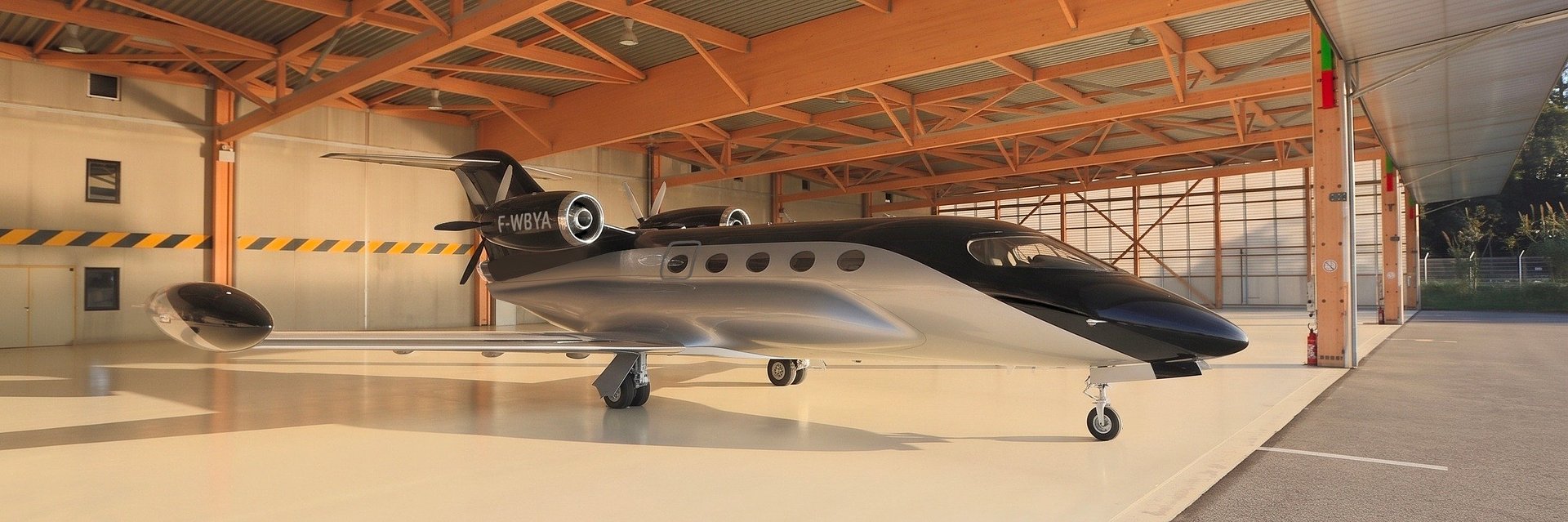
From aircraft to airport: Beyond Aero and Aéroports de la Côte d’Azur prepare for hydrogen operations

From aircraft to airport: Beyond Aero and Aéroports de la Côte d’Azur prepare for hydrogen operations

After nearly three years of collaboration, the partners are assessing a phased gaseous-hydrogen infrastructure designed to scale with the first volumes expected from the early 2030s.

NICE, France, 3 September 2026 - Beyond Aero and Aéroports de la Côte d’Azur today announced a partnership to prepare the operational conditions required to accommodate the first hydrogen-electric business aircraft at Nice Côte d’Azur, Cannes Mandelieu and Golfe de Saint-Tropez airports. The announcement marks a new stage in a collaboration that began nearly three years ago.  Aéroports de la Côte d’Azur, Europe’s second-largest airport group for business aviation, is working with Beyond Aero to define a phased strategy for deploying hydrogen infrastructure in line with the expected ramp-up of operations from the early 2030s.
Beyond Aero is developing One, a six- to eight-seat business aircraft designed around electric propulsion powered by hydrogen fuel cells. Entry into service is targeted for the early 2030s.

Preparing aircraft and infrastructure in parallel

The development of this new generation of aircraft must be matched by the preparation of airport infrastructure. Initial demand from business aviation will, however, remain limited compared with commercial aviation. This makes it possible to consider targeted, scalable installations sized to actual demand.
Beyond Aero and Aéroports de la Côte d’Azur are assessing hydrogen supply, storage, distribution and refuelling scenarios, together with their technical, operational, regulatory and economic integration across the three airports.
The work includes defining required capacity, identifying suitable locations, developing the operating concept for refuelling and estimating the level of investment associated with different deployment scenarios.

Infrastructure readiness must advance at the same pace as aircraft development. With Aéroports de la Côte d’Azur, we are working from practical scenarios tailored to business aviation volumes and based on available technologies. This phased approach is essential to enable safe, viable operations when the first aircraft enter service.

Eloa Guillotin, co-founder and CEO of Beyond Aero

Gaseous hydrogen as a pragmatic first step

The preferred scenario at this stage is based on compressed gaseous hydrogen. This solution is consistent with Beyond Aero’s aircraft architecture and relies on technologies that are already available and suitable for industrial deployment. Hydrogen could be produced outside the airport perimeter, close to the airports, and transported by tube trailer to an on-airport dispensing station. Nearby production could also serve other local uses, pooling demand and supporting the development of a regional hydrogen ecosystem.
Two refuelling solutions are under assessment:
  • a fixed dispenser located near a dedicated parking area for hydrogen aircraft; and
  • a mobile refuelling vehicle operating between the dispensing station and the aircraft.
These configurations would limit initial capital expenditure and allow capacity to scale progressively as aircraft numbers and operating frequencies increase.

Our role is to anticipate the needs of future operators while ensuring that our infrastructure meets safety and performance requirements and remains economically viable. This partnership turns our environmental ambition into practical, phased operational solutions.

Franck Goldnadel, Chairman of the Management Board of Aéroports de la Côte d’Azur.

Cannes Mandelieu: the first airport under consideration

While the work covers all three airports operated by the group, Cannes Mandelieu currently appears to offer the most suitable conditions for an initial deployment. A major business aviation airport on the French Riviera and a key gateway to Monaco, it handles traffic representative of One’s future use cases. Its configuration also makes it possible to assess how hydrogen infrastructure could be integrated into a high-activity airport environment.
This initial study will assess the practical conditions for integrating refuelling operations while accounting for safety requirements, operational performance and economic viability. It will also evaluate the expected benefits of hydrogen-electric aircraft in reducing noise and local emissions.

A phased strategy aligned with operational growth

The study is not intended solely to define an end-state infrastructure. It will establish a phased pathway aligned with different market-adoption scenarios and actual demand. The partners aim to avoid overbuilding at the outset while ensuring that capacity can expand as hydrogen operations develop.
Over the longer term, the approach could include other hydrogen uses at the airports, such as selected service vehicles or ground-support equipment where relevant synergies exist. No final investment or siting decision has been made at this stage. The next phases of the work will compare the different configurations and recommend the solution best suited to each airport.
By anticipating technical and operational requirements now, Beyond Aero and Aéroports de la Côte d’Azur intend to be ready for the arrival of the first hydrogen-electric aircraft and to position the group’s airports among the first in Europe to make practical preparations for this new generation of aircraft.

About Aéroports de la Côte d’Azur

Aéroports de la Côte d’Azur operates Nice Côte d’Azur Airport, France’s second-largest airport, as well as Cannes Mandelieu and Golfe de Saint-Tropez airports. The group ranks second in Europe for business aviation. Nice Côte d’Azur Airport holds Level 5 Airport Carbon Accreditation from Airports Council International (ACI), while Cannes Mandelieu and Golfe de Saint-Tropez airports hold Level 4+ accreditation. Aéroports de la Côte d’Azur has been a privately owned group since 2016, with a majority stake held by the Azzurra consortium.

À propos de Beyond Aero

Beyond Aero is building the first electric business aircraft powered by hydrogen propulsion, enabling six passengers to fly up to 800 NM (1,500 km), a range unattainable with battery-electric aircraft. Founded in December 2020, the company is redesigning the architecture of an aircraft around hydrogen-electric propulsion, focusing on fuel cell technology, gaseous hydrogen tank integration, and advanced cooling systems. With offices in Toulouse, Paris, and Los Angeles, the company boasts a team of over 80 highly qualified engineers from leading aerospace companies. Beyond Aero has secured over $50 million in funding, backed by investors such as Giant Ventures, Bpifrance, and prior supporters like Initialized Capital, Female Founders Fund, and 7 Percent Ventures. Beyond Aero also completed Y Combinator in 2022. The company has secured $2bn in Letters of Intent (LOIs), completed France’s first manned, fully hydrogen-electric flight, and acquired Universal Hydrogen Co.'s assets, IP, and flight data. Beyond Aero is a member of the World Economic Forum’s First Movers Coalition and the Alliance for Zero Emission Aviation, underscoring its commitment to electrifying aviation with hydrogen propulsion.
Attachments

Download All

BYA_One_Nice.jpg

image | 5.29 MB

Download
Cannes_2.jpeg

image | 2.6 MB

Download
Cannes_1.png

image | 6.41 MB

Download
We use cookies to run our website, analyze your use of our services, manage your online preference & personalize ad content. By accepting our cookies, you’ll get relevant content and social media features, personalized ads, and an enhanced browsing experience. To manage your choices, click „Cookie Settings”. Necessary cookies are required for the core website functionality and cannot be rejected. For more information, see our Cookie Policy.
Cookie settings
Cookies used on the site are categorized and below you can read about each category and allow or deny some or all of them, except for Necessary Cookies which are required to provide core website functionality. When categories that have been previously allowed are disabled, all cookies assigned to that category will be removed from your browser. You can see a list of cookies assigned to each category and detailed information on those cookies in the “Cookie Policy” tab.
Necessary cookies
Some cookies are required to provide core functionality. The website won't function properly without these cookies and they are enabled by default and cannot be disabled.
Preferences
Preference cookies enables the website to remember information to customize how the website looks or behaves for each user. This may include storing selected currency region, language or color theme.
Analytical cookies
Analytical cookies help us improve our website by collecting and reporting information on its usage.
Marketing cookies
Marketing cookies are used to track visitors across websites to allow publishers to display relevant and engaging advertisements. By enabling marketing cookies, you grant permission for personalized advertising across various platforms.