

Estimate comes from Hedgepoint Global Markets, which maintains a positive bias amid favorable results recorded in several states
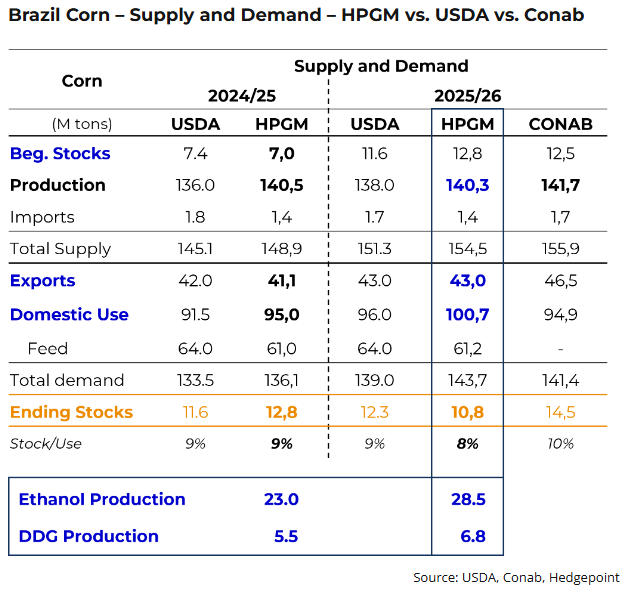
São Paulo, August 5, 2026 – Brazilian corn production for the 2025/26 season is estimated at around 140 million metric tons by Hedgepoint Global Markets, above the 138 million metric tons projected by the U.S. Department of Agriculture (USDA). The consultancy maintains a positive revision bias in August, as the second crop delivered favorable results in several states despite the problems recorded in Goiás.
The harvest is delayed in the Center-South, in line with the later planting schedule. So far, however, there are no signs of major availability issues in the country, although localized regional challenges may occur.

Exports maintain a strong pace, but Iran brings uncertainty
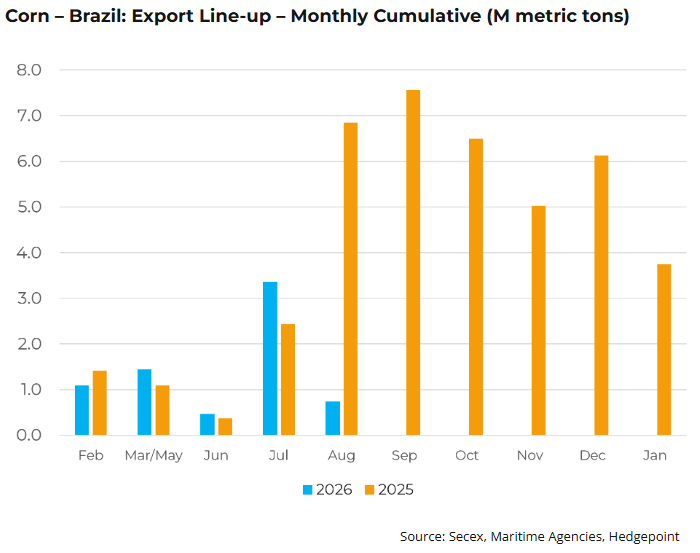
Brazilian shipment registrations are about 1 million metric tons ahead of last year. The continuation of this pace, however, faces a relevant risk related to Iran, the largest buyer of Brazilian corn in 2025, when it purchased approximately 9 million metric tons.
In 2026, sales to the Iranian market fell 36% through June, to 1.5 million metric tons, compared with 2.3 million in the same period of the previous year. The impact of the conflict in the Middle East on this trade flow is a point of attention for the second half of the year.
“In corn, the highlights are Argentina’s growing export strength and the geopolitical risk surrounding Brazilian sales to Iran, alongside the structural expansion of corn ethanol as a new pillar of domestic demand,” says Luiz Fernando G. Roque, Market Intelligence analyst at Hedgepoint Global Markets.

Ethanol consolidates a new consumption driver
Corn allocated to ethanol production already totals 28.5 million metric tons, 5.5 million more than in the previous year. If the 32% anhydrous ethanol blend in gasoline (E32), initially approved for 180 days, is confirmed permanently, additional corn consumption could reach approximately 1.5 million metric tons. If the measure remains in effect only for that period, estimated extra demand will be around 700,000 metric tons.
The expansion is also reflected in production capacity. The number of plants in operation rose from 27 to 29, while another 27 units are planned or under construction. According to Hedgepoint, the movement signals structural growth in the domestic market, which is expanding beyond the Midwest.
Argentina expands competition in the international market
Argentina has consolidated its position as the most competitive origin for corn, surpassing the United States. Brazil currently holds the least favorable position in South America, although the price difference is small and may be offset by quality and logistics.
For the 2025/26 season, the USDA estimates Argentine production at 63 million metric tons, while the Rosario Board of Trade puts it at 68 million. The country’s exports are projected at 45 million metric tons, compared with 29 million in 2024/25. This volume could exceed the 43 million forecast for Brazil, an estimate that carries a downward bias, and intensify competition between the two countries.

U.S. weather and the French crop enter the radar
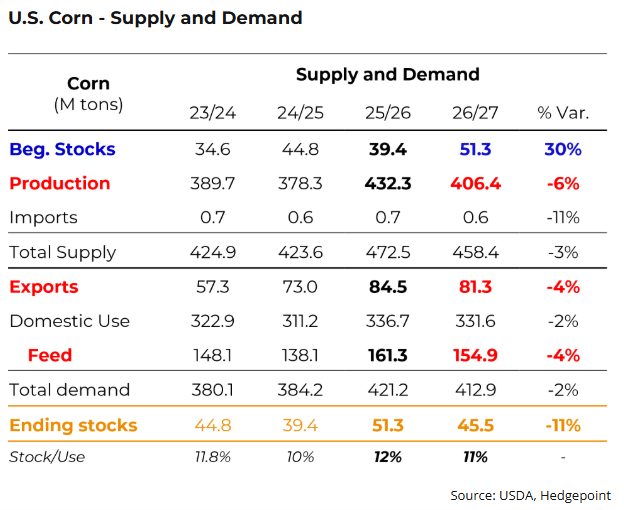
In the United States, the harvest could result in the second-largest production in history, although yields are already projected below the previous season. About 19% of the planted area is under drought, compared with approximately 9% last year, reinforcing the risk of negative yield adjustments if the weather does not improve in August.
U.S. exports already total 86.3 million metric tons, above the USDA estimate of 84.5 million, and remain an important support factor for prices in Chicago. Some of these registered volumes, however, may shift to the next cycle at the turn of the marketing year.
In the European Union, the deterioration of French crops may create room for other suppliers. Only 41% of France’s corn area is in good or excellent condition, while 31% is classified as poor or very poor. The outlook is for further production cuts and increased European imports, a movement that could benefit Brazil, Argentina, the United States, and Ukraine.
“As a result, this is a moment for caution and for constantly monitoring factors related to both weather and supply and demand, since several key figures are still open and could alter the market balance in the coming months,” Roque concludes.
About Hedgepoint Global Markets
Hedgepoint Global Markets is a company specialized in risk management, market intelligence, and hedge execution for the global commodities value chain, with extensive experience in agricultural and energy markets. It is present on five continents and offers clients hedge products based on technology and innovation, keeping the client at the center of all processes. The company works with more than 60 commodities and more than 450 hedge products on its platform. Visit our website.